Spatial perturbation response visualization (replot.py) - ganitumab sensitivity, 250um-Extended Model
import sys
import re
import pickle
import numpy as np
from scipy.stats import rankdata
from datasets import load_from_disk
from sklearn.cluster import KMeans
import matplotlib.pyplot as plt
import scanpy as sc
import pandas as pd
import math
import os
import gzip
import bz2
import lzma

if __name__=="__main__":
	pkl_file = sys.argv[1]
	with open(pkl_file, "rb") as f:
		plot_data = pickle.load(f)

	coord_x = plot_data["coord_x"]
	coord_y = plot_data["coord_y"]
	patients = plot_data["patient"]
	leiden = plot_data["leiden"]
	umap = plot_data["umap"]
	rbp_score = plot_data["rbp_score"]
	gene_names = plot_data["gene_names"]
	cluster_tables = plot_data["cluster_tables"]
	missing_by_sample = plot_data["missing_by_sample"]
	adata = plot_data["adata"]

	ig, axes = plt.subplots(1, 2, figsize=(12, 5))
	sc.pl.umap(adata, color='leiden', ax=axes[0], show=False, size=20, legend_loc='on data')
	axes[0].set_title("UMAP — Leiden Clusters")
	sc.pl.umap(adata, color='patient', ax=axes[1], show=False, size=20)
	axes[1].set_title("UMAP — Patient Labels")
	plt.tight_layout()
	plt.savefig("top100_umap_leiden_patient.pdf", dpi=300)
	plt.close()

	ig, axes = plt.subplots(1, 2, figsize=(12, 5))
	sc.pl.umap(adata, color='leiden', ax=axes[0], show=False, size=20, legend_loc='on data')
	axes[0].set_title("UMAP — Leiden Clusters")
	sc.pl.umap(adata, color='patient', ax=axes[1], show=False, size=20)
	axes[1].set_title("UMAP — Patient Labels")
	plt.tight_layout()
	plt.savefig("top100_umap_leiden_patient.pdf", dpi=300)
	plt.close()

	umap = adata.obsm["X_umap"]
	x = umap[:, 0]
	y = umap[:, 1]
	unique_patients = np.unique(patients)
	palette = sc.pl.palettes.default_20
	colors = {p: palette[i % len(palette)] for i, p in enumerate(unique_patients)}
	n = len(unique_patients)
	cols = 6                            # change to 4, 5, etc. if you prefer
	rows = int(np.ceil(n / cols))
	fig, axes = plt.subplots(rows, cols, figsize=(5*cols, 5*rows))
	axes = np.array(axes).reshape(rows, cols)
	for ax, patient in zip(axes.flatten(), unique_patients):
		mask = (patients == patient)
		ax.scatter(x[~mask], y[~mask], s=6, c="#dddddd", alpha=0.3, edgecolors="none")
		ax.scatter(x[mask], y[mask], s=12, c=colors[patient], label=patient, edgecolors="none")
		ax.set_title(f"Patient: {patient}", fontsize=12)
		ax.set_xticks([])
		ax.set_yticks([])
		ax.axis("off")
	for ax in axes.flatten()[n:]:
		ax.axis("off")
	plt.tight_layout()
	plt.savefig("top100_umap_by_patient_panels.png", dpi=300)
	plt.close()

	cluster_labels = leiden
	unique_clusters = sorted(np.unique(cluster_labels))
	print(unique_clusters)
	n_clusters = len(unique_clusters)
	cols = 3
	rows = math.ceil(n_clusters / cols)
	fig, axes = plt.subplots(rows, cols, figsize=(4 * cols, 3 * rows))
	axes = np.array(axes).reshape(rows, cols)
	for ax in axes.flatten()[n_clusters:]:
		ax.axis("off")
	for ax, cl in zip(axes.flatten(), unique_clusters):
		df = cluster_tables[cl]
		ax.axis("off")
		ax.set_title(f"Cluster {cl}", fontsize=10)
		cell_text = [[row["gene"], f"{int(row['count'])}", f"{row['fraction_cells']:.2f}"] for _, row in df.iterrows()]
		col_labels = ["gene", "count", "fraction_cells"]
		table = ax.table(cellText=cell_text, colLabels=col_labels, loc="center")
		table.auto_set_font_size(False)
		table.set_fontsize(8)
		table.scale(1.0, 1.2)  # tweak if needed
	plt.tight_layout()
	plt.savefig("top100_top_genes_per_cluster_tables.pdf", dpi=300)
	plt.close()

	tables = cluster_tables  # or top100_cluster_tables
	unique_clusters = sorted(tables.keys(), key=lambda x: int(x))
	n_clusters = len(unique_clusters)
	cols = 5
	rows = int(math.ceil(n_clusters / float(cols)))
	plt.figure(figsize=(1.5 * cols, 2.5 * rows))
	fig, axes = plt.subplots(rows, cols, figsize=(1.5 * cols, 2.5 * rows), sharex=False, sharey=False)
	axes = np.array(axes).reshape(rows, cols)

	for ax, cl in zip(axes.flatten(), unique_clusters):
		genes = tables[cl]["gene"]
		fracs = tables[cl]["fraction_cells"]
		y = np.arange(len(genes))
		ax.barh(y, fracs)
		ax.set_yticks(y)
		ax.set_yticklabels(genes)
		ax.invert_yaxis()
		ax.set_title(f"Cluster {cl}", fontsize=10)
		ax.set_xlabel("Fraction of cells")
		ax.set_ylim(-0.5, len(genes) - 0.5)
	for ax in axes.flatten()[n_clusters:]:
		ax.axis("off")
	plt.tight_layout()
	plt.savefig("horizontal_barplots_by_cluster.png", dpi=300)
	plt.close()

	unique_patients = np.unique(patients)
	unique_clusters = sorted(np.unique(cluster_labels))
	palette = sc.pl.palettes.default_20
	cluster_color_map = {cl: palette[i % len(palette)] for i, cl in enumerate(unique_clusters)}
	n_patients = len(unique_patients)
	cols = 5  # tweak grid
	rows = int(math.ceil(n_patients / cols))
	fig, axes = plt.subplots(rows, cols, figsize=(4 * cols, 4 * rows), sharex=False, sharey=False)
	axes = np.array(axes).reshape(rows, cols)
	for ax, patient in zip(axes.flatten(), unique_patients):
		mask_patient = (patients == patient)
		for cl in unique_clusters:
			mask = mask_patient & (cluster_labels == cl)
			if not np.any(mask):
				continue
			ax.scatter(coord_x[mask], coord_y[mask], s=20, c=cluster_color_map[cl], edgecolors="none")
		ax.set_title(f"Patient: {patient}", fontsize=10)
		ax.set_xticks([])
		ax.set_yticks([])
		ax.invert_yaxis()
	for ax in axes.flatten()[n_patients:]:
		ax.axis("off")

    # Global legend for clusters
	handles = [plt.Line2D([0], [0], marker="o", linestyle="", markersize=15, color=cluster_color_map[cl],
		label=f"Cluster {cl}") for cl in unique_clusters]
	fig.legend(handles=handles, loc="center right", title="Leiden clusters", bbox_to_anchor=(0.98, 0.5), frameon=True)
	plt.tight_layout()
	plt.subplots_adjust(right=0.85)
	plt.savefig("top100_spatial_by_patient_clusters.png", dpi=300)
	plt.close()

	full_sample = plot_data["full_sample"]
	full_x = plot_data["full_x"]
	full_y = plot_data["full_y"]
	full_barcode = plot_data["full_barcode"]

	barcodes = adata.obs["barcode"]
	sub_sample = patients
	sub_barcode = barcodes
	sub_x = coord_x
	sub_y = coord_y
	matched_samples = set(np.intersect1d(np.unique(full_sample), np.unique(sub_sample)))

	full_by_sample = {}
	for i in range(full_sample.shape[0]):
		sid = full_sample[i]
		if sid not in matched_samples:
			continue
		if sid not in full_by_sample:
			full_by_sample[sid] = {"barcode": [], "x": [], "y": []}
		full_by_sample[sid]["barcode"].append(full_barcode[i])
		full_by_sample[sid]["x"].append(full_x[i])
		full_by_sample[sid]["y"].append(full_y[i])

	sub_barcode_set_by_sample = {}
	for i in range(sub_sample.shape[0]):
		sid = sub_sample[i]
		if sid not in matched_samples:
			continue
		if sid not in sub_barcode_set_by_sample:
			sub_barcode_set_by_sample[sid] = set()
		sub_barcode_set_by_sample[sid].add(sub_barcode[i])

	missing_by_sample = {}
	for sid in matched_samples:
		if sid not in full_by_sample:
			continue
		fb = full_by_sample[sid]
		sub_set = sub_barcode_set_by_sample.get(sid, set())
		miss_x = []
		miss_y = []
		for b, x, y in zip(fb["barcode"], fb["x"], fb["y"]):
			if b not in sub_set:
				miss_x.append(x)
				miss_y.append(y)
		if len(miss_x) > 0:
			missing_by_sample[sid] = (np.array(miss_x), np.array(miss_y))

	scores = rbp_score
	unique_patients = sorted(np.unique(patients))
	n_patients = len(unique_patients)
	vmin = np.percentile(scores, 5)
	vmax = np.percentile(scores, 90)
	cols = 5  # tweak as needed
	rows = int(np.ceil(n_patients / float(cols)))
	fig, axes = plt.subplots(rows, cols, figsize=(4 * cols, 4 * rows), sharex=False, sharey=False)
	axes = np.array(axes).reshape(rows, cols)
	last_scatter = None

	print(unique_patients)
	new_patients = ["4739739_1142243F", "4739739_1160920F", "4739739_CID4290", "4739739_CID4535", "GSE210616_GSM6433586_092B",
	"GSE210616_GSM6433589_093C", "GSE210616_GSM6433590_093D",
	"GSE210616_GSM6433591_094A", "GSE210616_GSM6433592_094B", "GSE210616_GSM6433599_117D", "GSE210616_GSM6433600_117E", "GSE210616_GSM6433601_118B",
	"GSE210616_GSM6433602_118C", "GSE210616_GSM6433613_395A", "GSE210616_GSM6433618_396C"]
	new_patients = [nn for nn in new_patients if nn in unique_patients]
	remain_patients = [un for un in unique_patients if un not in new_patients]
	unique_patients = new_patients + remain_patients

	for ax, patient in zip(axes.flatten(), unique_patients):
		#ax.set_facecolor("black")
		mask = (patients == patient)
		if not np.any(mask):
			ax.axis("off")
			continue
		sample_ids_p = set(np.unique(sub_sample[mask]))
		for sid in sample_ids_p:
			if sid in missing_by_sample:
				mx, my = missing_by_sample[sid]
				if patient.startswith("4739739"):
					ax.scatter(mx, -my, s=10, c="grey", edgecolors="none", alpha=0.6)
				else:
					ax.scatter(-my, mx, s=10, c="grey", edgecolors="none", alpha=0.6)
		if patient.startswith("4739739"):
			last_scatter = ax.scatter(coord_x[mask], -coord_y[mask], c=scores[mask], s=20, cmap="inferno", vmin=vmin, vmax=vmax)
		else:
			last_scatter = ax.scatter(-coord_y[mask], coord_x[mask], c=scores[mask], s=20, cmap="inferno", vmin=vmin, vmax=vmax)

		ax.set_title(f"Patient: {patient}", fontsize=10)
		ax.invert_yaxis()  # often needed for Visium-style coords
		ax.set_xticks([])
		ax.set_yticks([])

	for ax in axes.flatten()[len(unique_patients):]:
		ax.axis("off")

	fig.subplots_adjust(right=0.88)
	cax = fig.add_axes([0.90, 0.15, 0.02, 0.70])
	if last_scatter is not None:
		fig.colorbar(last_scatter, cax=cax, label="RBP score")

	plt.tight_layout(rect = [0, 0, 0.88, 1])
	plt.savefig("rbp_score_spatial_by_patient.png", dpi=300)
	plt.close()
Running Command
python3 replot.py replot_bundle_1000_run-1ecffb18.pkl
This loads a pickle file containing the results.
Results
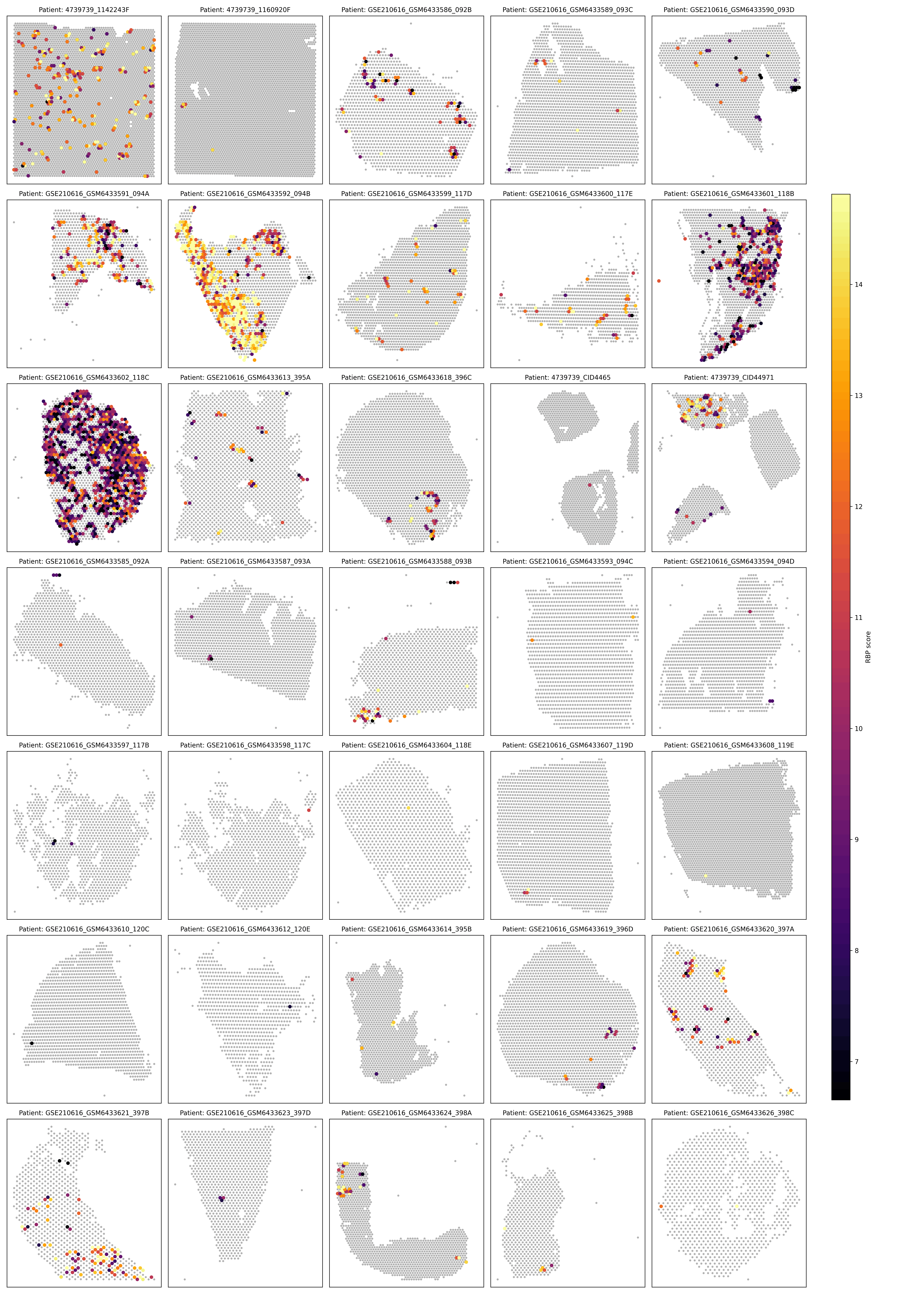
rbp_score_spatial_by_patient.png:
Shows the sensitivity score of ganitumab treatment per spot per spatial transcriptomic sample. Here they are TNBC samples. 3 samples specifically exhibit higher sensitivity score than rest.
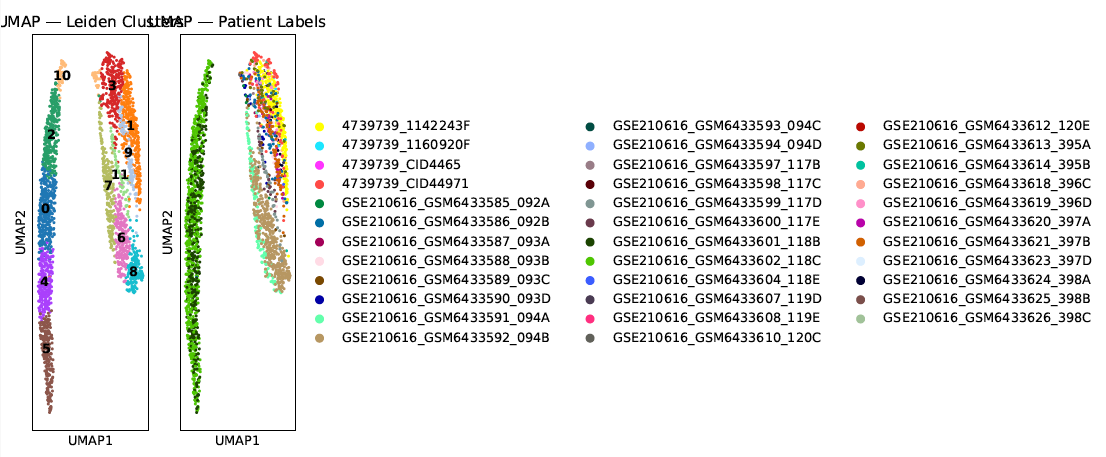
top100_umap_leiden_patient.png:
Shows how ST spots cluster by sensitivity profiles. Spot-by-gene response matrix (for top 100 response genes and IGF1R-expressing spots) was used for Leiden clustering followed by UMAP visualization.
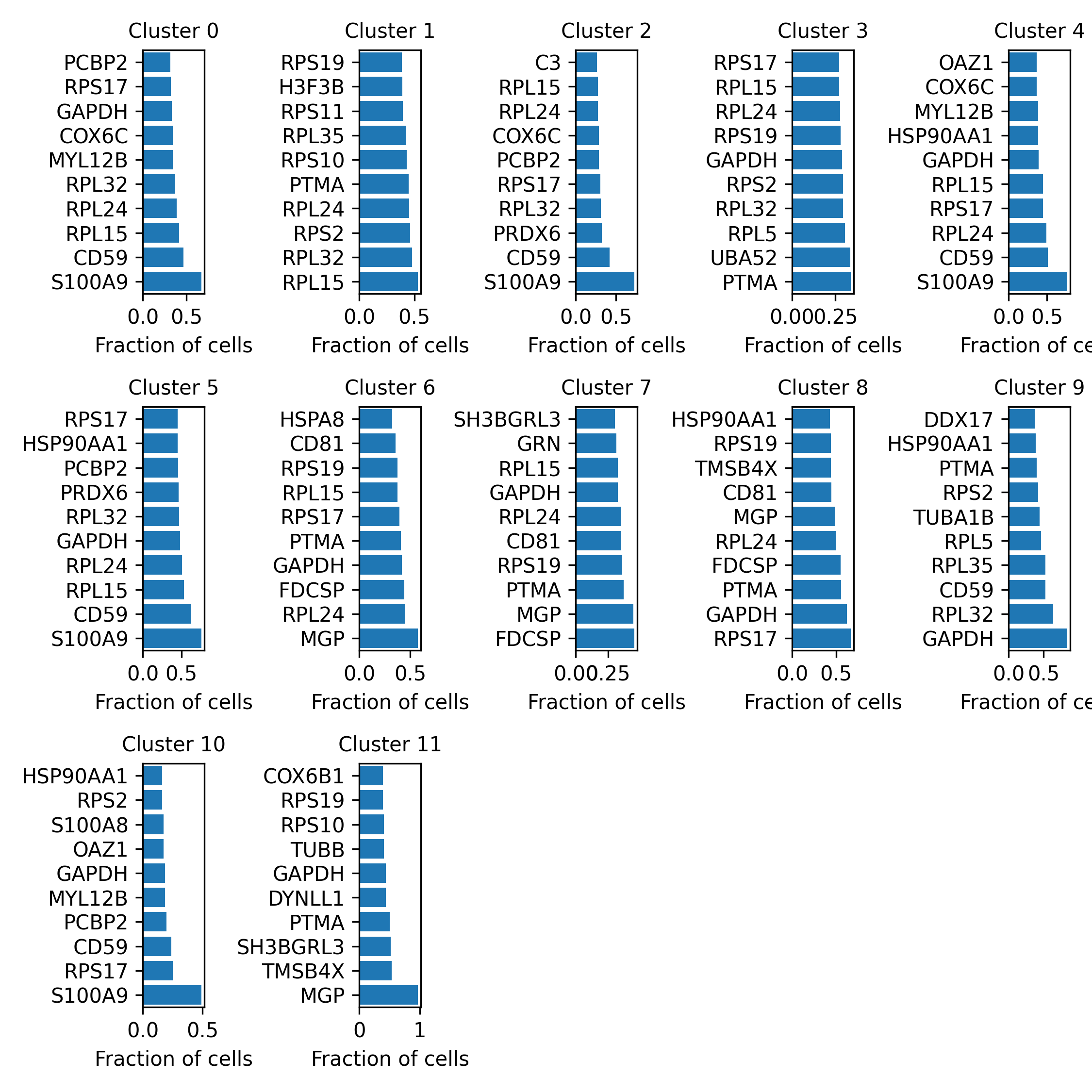
horizontal_barplots_by_cluster.png:
Shows the top 10 marker genes of each sensitivity spot-cluster. Marker genes represent sensitive genes.
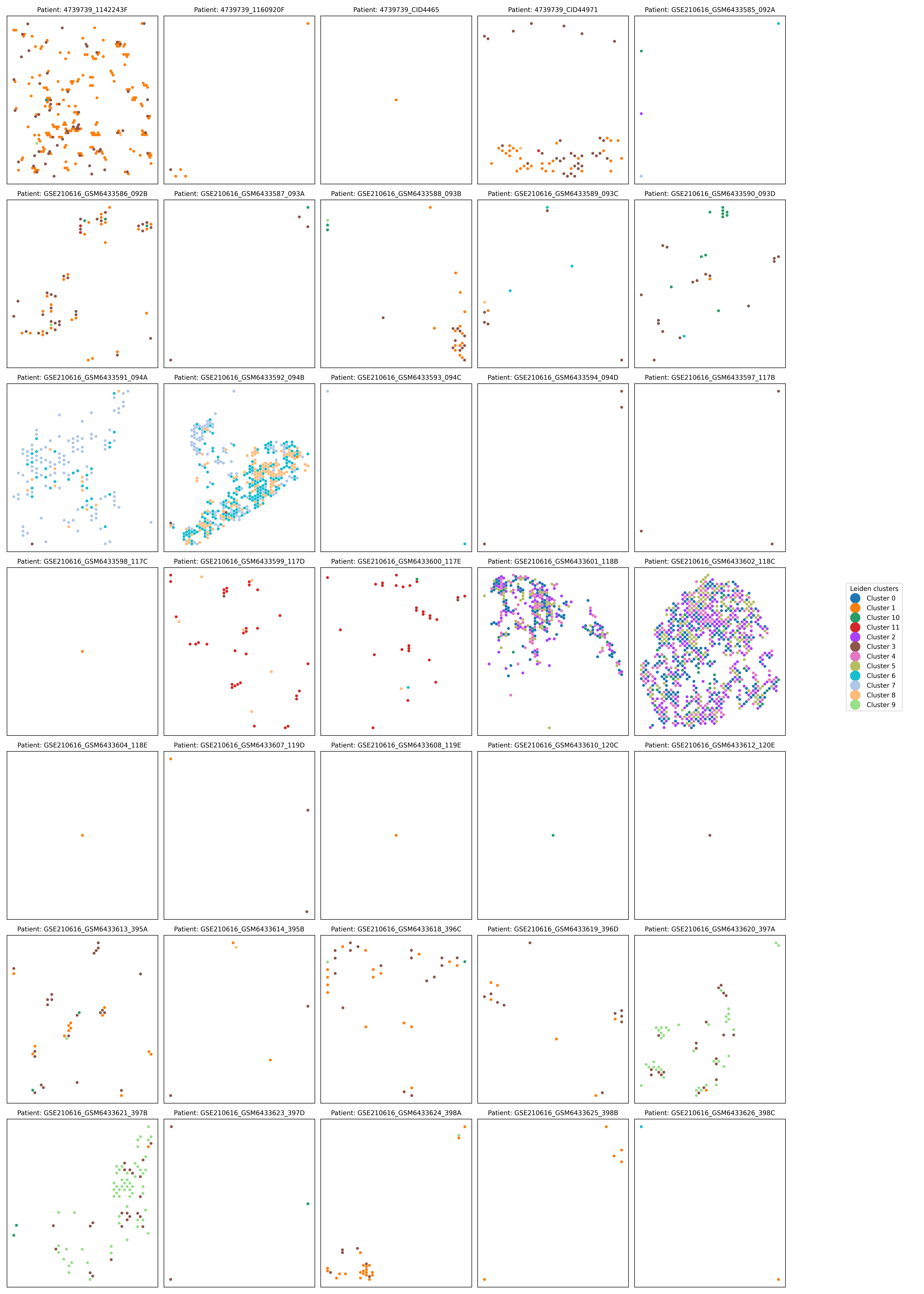
top100_spatial_by_patient_clusters.png:
Shows how sensitivity clusters distribute spatially across ST samples.
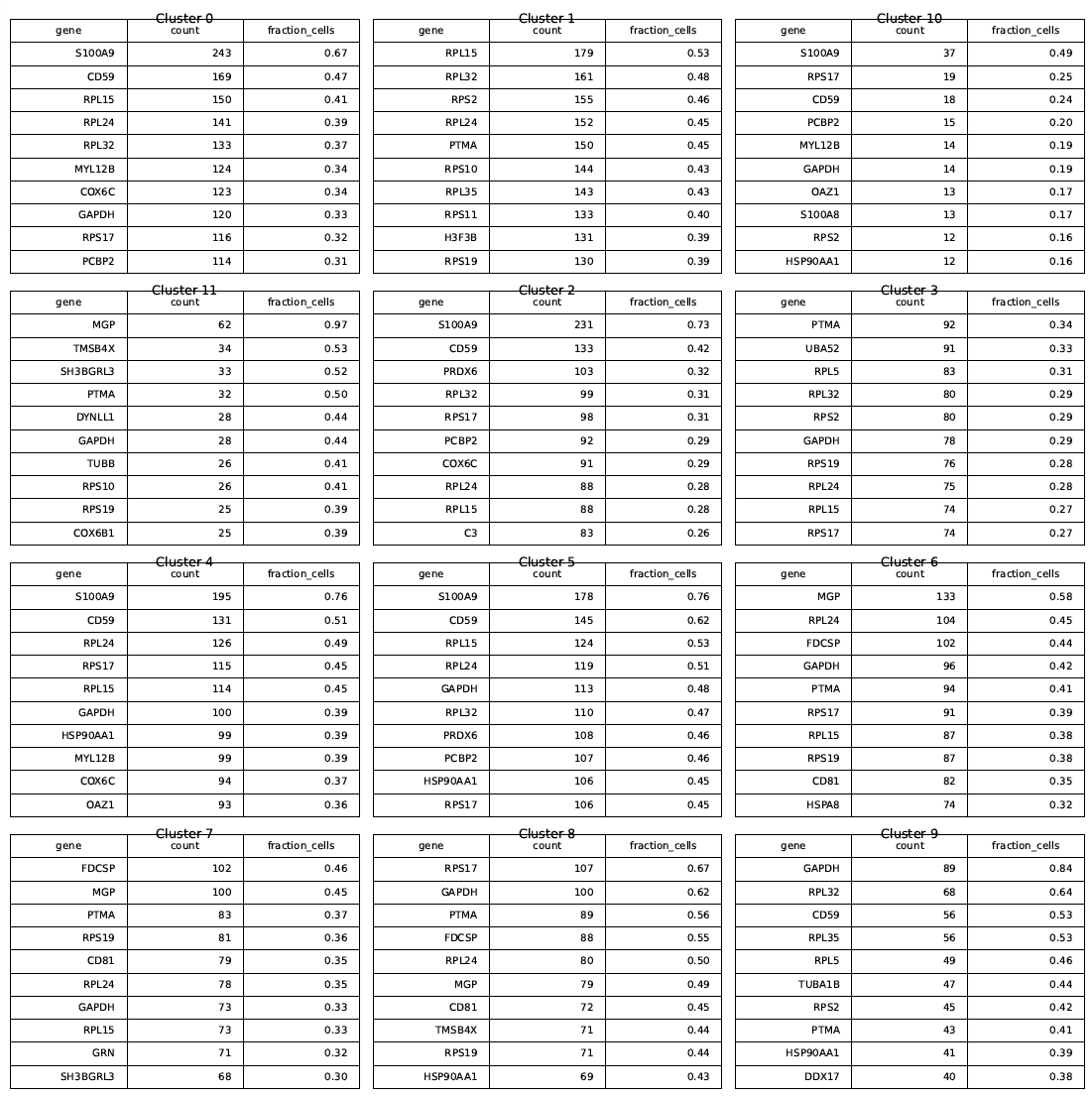
top100_top_genes_per_cluster_tables.png:
Shows the source data for the marker gene horizontal bar plot above.